Guide
Villa Construction Payment Schedule in Bangalore
Stage-wise payment schedules for Bangalore villas — mobilisation, RCC, envelope, outdoor works, finishes, retention and GST invoices.
Quick summary
Stage-wise payment schedules for Bangalore villas — mobilisation, RCC, envelope, outdoor works, finishes, retention and GST invoices.
Quick Summary
A villa payment schedule is the owner’s primary control on cash, quality, and leverage across a longer, heavier programme than a compact house.
Bangalore villas — larger footprints, more wet areas, bigger terraces, compound and often landscape or pool packages — need stage definitions tied to verified work, not to calendar optimism or vague “fifty percent structure” language.
This chapter sets out principles, a practical stage model, GST and running-account discipline, monsoon realities, and how to link payments to Waterproofing tests and Finishing gates.
Use this together with your villa cost guide and Construction Calculator: derive percentages from a real BOQ and inclusions list for Villa Construction, then attach the schedule as a contract annexure.
Front-loaded schedules that demand large advances without mobilisation definition are risk signals; schedules that starve foundation and terrace Waterproofing stages of fair cash also damage quality.
Decision Framework
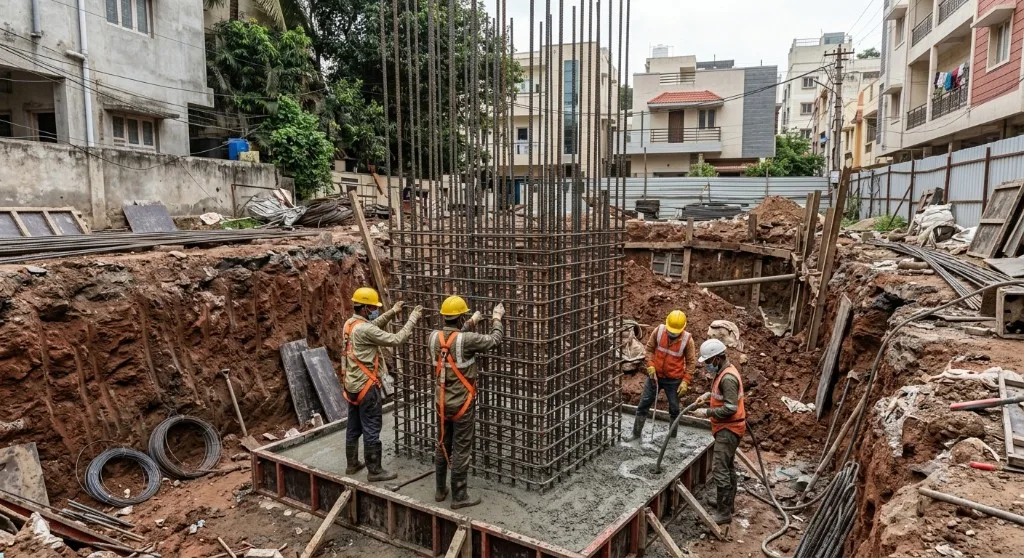
Build the schedule from scope, not from habit. List packages: building structure and envelope, Waterproofing, MEP, Finishing, compound, optional landscape, optional pool. Assign each payment to a photographable state and an inspection artefact. Cap mobilisation. Split RCC by level.
Split finishes by trade completion. Hold retention through handover and a defects window. If a bidder’s cash curve differs radically from peers at the same total price, interrogate why — early procurement of long-lead fenestration can justify some front-loading; unexplained advance hunger cannot.
| Question | Healthy answer | Risk signal |
|---|---|---|
| What unlocks each rupee? | Named physical stage + inspection note | “Progress” or “as mutually discussed” |
| How large is mobilisation? | Limited, receipted, adjustable against early bills | 20–40% with vague site setup story |
| How is RCC paid? | Per slab / level after curing milestones | One lumped “RCC complete” cheque |
| When is terrace money released? | After Waterproofing flood test record | After “coating looks done” |
| Is outdoor work separate? | Own stages for compound / landscape / pool | Hidden inside building percentages |
| Retention? | Held to handover + defects conditions | Waived because move-in excitement |
Principles for villa-scale cash flow
Villas burn more cash early in excavation, foundations, and retaining on sloping Sarjapur or Kanakapura-type plots, and more cash late in Finishing across many rooms. Whitefield villas with large terraces overweight Waterproofing and protection screeds mid-programme. Electronic City projects may see logistics-driven material stocking needs — still require stock to be for your site, receipted, and insured, not a general warehouse deposit.
Separate owner statutory costs (plan sanction, betterment, deposits) from contractor stage bills. Separate owner-supplied modular kitchens or stones from turnkey billing. Keep one running account: contract value, variations, billed, paid, retention, balance.
| Item | Detail |
|---|---|
| Pay for verified states | Not for dates or optimism |
| Match working capital | Fair cash for heavy foundation and long-lead items listed in writing |
| Preserve leverage | Retention and unfinished Finishing tranches until snags close |
| Document packs | Invoice + stage certificate + photos + updated running account |
Process
Illustrative stage model (adapt to your BOQ)
Percentages are indicative patterns for a G+1 or G+2 villa building package excluding land and major pool. Re-fit to your Villa Construction contract; slope and basement change early weights.
| Stage | Indicative share of building contract | Release condition (examples) |
|---|---|---|
| Mobilisation advance | 5–10% | Agreement signed; site setup defined; advance bond/receipt as agreed |
| Foundation / plinth | 12–18% | Footings/raft to drawing; engineer review; plinth level locked |
| Each structural slab / level | 8–12% per level (split as designed) | Casting complete; curing milestone; cover notes |
| Masonry to roof / envelope | 8–12% | Walls to agreed level; openings true |
| Roof / terrace Waterproofing | 5–8% | System complete; flood test passed |
| Internal plaster + MEP rough-in | 8–12% | Areas measured; pressure/insulation tests before conceal |
| Flooring + joinery + painting (split) | 15–22% | Trade-wise completion; make-list conformance |
| Practical completion | 5–8% | Snag list closed to agreed standard |
| Retention | 5% (typical band) | Handover pack + defects-liability rules |
| Package | Suggested payment logic | Do not |
|---|---|---|
| Compound / driveway | After drains and falls verified | Pay full on “interlock delivered” |
| Landscape softscape | After hardscape complete; partial on planting; balance after establishment period | Pay 100% on day of turf laying |
| Swimming pool | Shell; Waterproofing test; tiling/equipment; commissioning — separate stages | Blend into villa “finishing” percentage |
| Owner-supplied finishes | Owner pays vendors; contractor labour stage separate | Mix into contractor invoice without tracking |
Linking money to inspections and monsoon reality
Inspection rights should be contractual. Structural stages need engineer checklists. Wet areas need Waterproofing flood-test records. MEP needs pressure and insulation tests before plaster closes walls. Finishing stages need make-list verification — silent sanitaryware substitution is a payment integrity issue as much as a quality issue.
Monsoon weeks may slow external plaster, terrace membranes, and landscape. A good schedule anticipates lower burn without inventing unsafe pours to unlock invoices.
Align bank loan disbursement formats with your stage names early so lender certificates and contractor invoices tell the same story — a common Whitefield and Sarjapur villa friction point when loan officers and site engineers use different glossaries.
Money
Worked cash-flow example
Consider a mid-premium G+1 villa building contract of roughly ₹1.2 crore (illustrative only — always replace with your BOQ).
A disciplined curve might release about ₹8–10 lakh on mobilisation after agreement; ₹18–20 lakh after foundation and plinth verification; successive slab tranches of roughly ₹10–12 lakh each; masonry and plaster packages in the ₹10–14 lakh band; a Waterproofing-linked terrace release of ₹6–8 lakh only after flood test; Finishing split across flooring, joinery, and painting in several ₹6–10 lakh releases; then practical completion and retention.
The exact rupees matter less than the pattern: heavy early structure is funded fairly, mid-programme Waterproofing is not skipped, and late Finishing does not unlock early.
If the same owner adds a ₹30 lakh outdoor and pool package, that spend should appear on a second curve — shell, test, finish, commission — not as an informal top-up taken from the villa painting tranche.
Families who fund a pool by delaying terrace membrane payments usually meet both failures in the same monsoon. Keep the Construction Calculator columns separate so lifestyle packages cannot quietly cannibalise structural quality.
| Cash-flow stress test | What to check | Healthy response |
|---|---|---|
| Loan lag | Bank stage vs contract stage names | Align certificates before mobilisation |
| Monsoon pause | External works delayed 3–6 weeks | Buffer in programme; no fake pours |
| Variation spike | Stone upgrade + extra bath | Written order; revise running account |
| Pool added mid-build | New excavation beside foundations | Separate BOQ and payment annexure |
| Move-in pressure | Guests booked; snags open | Hold retention; partial occupation rules if any |
GST, variations, and running account
Insist on tax invoices per stage. Variations — extra bathroom, upgraded stone, extended compound — need written change orders with INR and time impact before execution. Verbal upgrades destroy both payment schedules and trust. Reconcile monthly even if you pay less often.
If you use a Construction Calculator for feasibility, update it when variations accumulate so family cash-flow planning stays honest against the villa cost guide baseline.
| Item | Detail |
|---|---|
| Contract value | Base BOQ total |
| Approved variations | Written only |
| Cumulative billed / paid | Tracked on one sheet |
| Retention held | Visible, not informal |
| Statutory owner costs | Separate cash column |
Professional recommendations
Attach the payment schedule to the Villa Construction contract with stage photoset definitions. Cap mobilisation. Pay Waterproofing on tests. Split Finishing. Keep outdoor and pool packages on their own curves. Review running account in every site meeting.
Prefer bidders who welcome inspection gates over those who push for emotional early releases. Contact the builder’s commercial lead before site mobilisation to freeze the annexure — not after the first argument.
Watch out
Common mistakes
- Large advances without recovery plan or mobilisation definition
- Vague percentage stages that cannot be measured on a villa floor plate
- Releasing terrace money before flood tests
- Bundling landscape and pool into building finishing percentages
- Paying retention at key handover because guests are invited
- Approving variations on WhatsApp without price and time impact
- Ignoring loan disbursement mismatch until cash runs short
Checklist
Owner checklist
| Item | Detail |
|---|---|
| Annexure | Payment schedule attached with stage definitions |
| Mobilisation | Cap and adjustment mechanism written |
| Structure | Per-level release rules clear |
| Waterproofing | Test-linked payment for toilets and terrace |
| Finishing | Trade-wise splits and make-list checks |
| Outdoor / pool | Separate schedules if in scope |
| Retention | Percentage and release conditions agreed |
| Running account | Template shared from day one |
FAQ
Frequently asked questions
Should villa payments differ from house construction schedules?
In principle they follow the same ethics — pay for verified stages — but villas usually need finer splits for terrace Waterproofing, more bathrooms, and external packages. Copying a compact-house schedule onto a large Whitefield villa often overpays envelope and under-controls Finishing.
How much retention is reasonable?
Often around five percent of contract value, sometimes split between practical completion and end of defects liability. The right figure is the one that keeps leverage through the first monsoon without unfairly starving a competent contractor — write release evidence clearly.
Can I pay more early to “get better attention”?
Extra early cash rarely buys quality; it buys reduced leverage. Attention is bought with clear specifications, inspection presence, and fair on-time payment of certified amounts — not with unearned advances.
Where do landscape-related decisions fit in cash flow?
After building envelope and drainage levels are stable enough. Paying full softscape early while terrace Waterproofing is untested is a classic priority error. Sequence money the way you sequence risk.
Final CTA
Design the payment schedule with the same care as the structural grid. For Villa Construction in Bangalore — whether Whitefield, Sarjapur, or Electronic City — tie every major release to proof, protect Waterproofing and Finishing gates, and keep outdoor packages visible.
Stress-test the curve with your villa cost guide and Construction Calculator, then Contact VDM Constructions to align a stage annexure that funds real progress without surrendering control.
More questions
Yes when outdoor is a meaningful package. Mixing landscape payments into vague “finishing” percentages invites unfinished drains and incomplete compounds.
Keep it modest and written. Large advances before soil reports, drawings and site readiness reduce your leverage on quality and programme.
A small percentage until snag closure and document handover is common. It should be defined in the contract with release conditions.