Guide
Villa Project Management in Bangalore
How owners and builders run villa programmes — stage gates, documentation, quality and cash-flow discipline.
Quick summary
How owners and builders run villa programmes — stage gates, documentation, quality and cash-flow discipline.
Quick Summary
Villa project management in Bangalore is the discipline of coordinating design, sanction, structure, waterproofing, finishes, outdoor works, cash flow, and owner decisions so a 3,000–6,000+ sq ft home finishes as one coherent building — not as five overlapping vendors improvising on a Whitefield or Sarjapur plot.
Compact houses sometimes survive informal WhatsApp coordination. Villas rarely do: more bathrooms, larger terraces, longer service runs, compound development, and monsoon-sensitive envelopes multiply interfaces.
This handbook chapter explains how owners should structure governance, stage gates, reporting, and decision rights when engaging Villa Construction or a Turnkey package.
Treat project management as a paid function with a named owner-side coordinator and a contractor-side project manager, not as “someone on site with a measuring tape.” Use the Construction Calculator and villa cost guide to set envelopes early, then manage against a BOQ and programme — never against optimism.
Location realities in Whitefield, Sarjapur, Electronic City, and Devanahalli change logistics, soil risk, and outdoor scope; they belong in the baseline plan, not in surprise variations.
Why villa projects need formal management
A villa programme spans consultants (architect, structural engineer, MEP), authority sanction, RMC and steel logistics, specialised waterproofing, multi-trade finishing, and outdoor civil works. Each interface can slip a week; five slipped interfaces become a season.
Bangalore’s monsoon and corridor-road access constraints make recovery expensive.
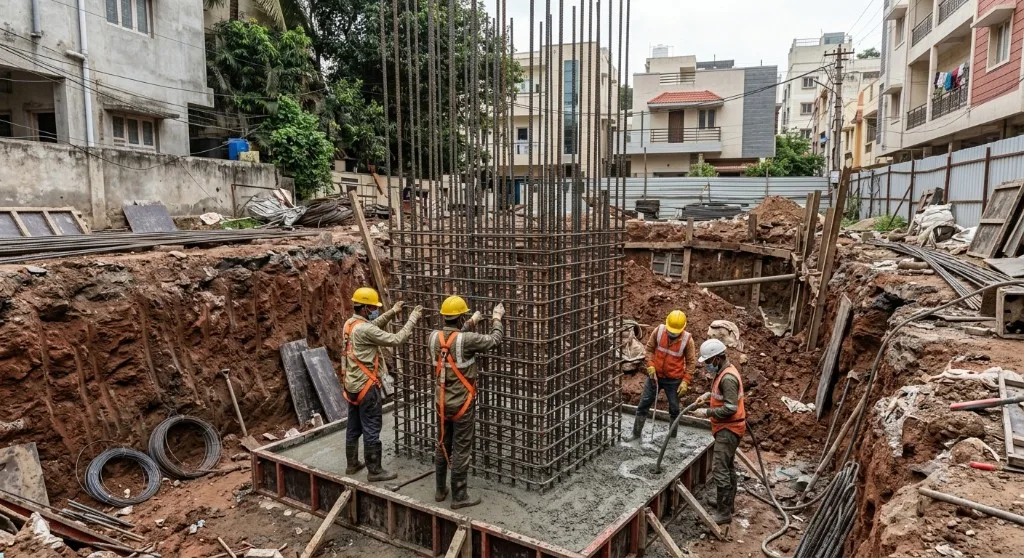
Informal management — owner visiting on Sundays, contractor “updating” by phone — consistently fails on concealment stages: cover to reinforcement, membrane coats before tile, compaction under driveway, and fall verification in wet areas.
Formal management does not mean bureaucracy for its own sake. It means a single source of truth for drawings, a dated programme with hold points, a variation register, photo evidence of concealed work, and payment releases tied to verified states.
Whether you choose item-rate Villa Construction or a Turnkey engagement, those artefacts remain mandatory. Turnkey only changes who employs the trades — it does not remove the need for gates and records.
| Management artefact | Owner benefit | Failure if missing |
|---|---|---|
| Master drawing register | One current set for site and consultants | Wrong openings, rework, blame cycles |
| Stage-gate programme | Cash and curing aligned | Unsafe acceleration; monsoon clashes |
| Inspection & test plan | Concealment stages witnessed | Leaks and settlement discovered late |
| Variation register | Cost and time impact visible | Silent scope creep; bitter handover |
| Monthly RA reconciliation | GST and quantities tracked | Payment disputes; lender friction |
| Snag & document pack plan | Handover is contractual | Keys without warranties or as-builts |
Decision Framework
Use this framework before mobilisation and revisit it at every major stage release on your Bangalore villa:
- If drawings, soil adoption, and sanction status are incomplete — do not mobilise excavation as if the design were frozen.
- If the contractor cannot name a resident or dedicated project manager and a weekly reporting format — treat the bid as incomplete regardless of price.
- If waterproofing and outdoor drainage are not on the critical-path calendar — redesign the programme before debating marble brands.
- If payment stages do not map to inspection gates — rewrite the schedule; calendar payments destroy quality leverage.
- If the plot sits on a sloping Sarjapur or Kanakapura edge, or on filled Whitefield land — elevate foundation and retaining reviews to board-level decisions, not site improvisation.
| Condition | Management action | Payment posture |
|---|---|---|
| Drawings still changing weekly | Freeze change window; issue revision protocol | Hold mobilisation beyond agreed site setup |
| Soil report conflicts with assumed footings | Structural redesign before cages | Do not pay foundation tranche on old design |
| Monsoon window hits terrace membrane | Protect or reschedule; never fake dry conditions | Pay for protection works if scoped; not for rushed coats |
| Owner selections lagging | Issue decision deadlines with default specs | Do not accept delay claims caused by late choices |
| Vendor count exploding | Consolidate under one PM calendar | Reject parallel invoices without coordination proof |
Roles and RACI for Bangalore villa builds
Clarify who decides, who advises, who executes, and who is informed. Owners often over-decide finishes and under-decide structure and waterproofing. Invert that. Architect owns spatial and aesthetic intent within sanctioned envelopes. Structural engineer owns load path and foundation type.
Contractor project manager owns sequence, labour, procurement logistics, and site safety. Owner-side coordinator owns approvals turnaround, payment pack review, and consultant chasing. Interior designer owns finishes after substrates and waterproofing extents are fixed — not before.
| Item | Detail |
|---|---|
| Owner | Priority list, budget envelope, stage payment authority, make-list lock |
| Owner coordinator | Meeting cadence, document control, inspection attendance |
| Architect | Drawing revisions, sanction liaison support, elevation integrity |
| Structural engineer | Design changes, pour clearances, foundation adoption |
| Contractor PM | Programme, subcontractors, quality records, RA bills |
| Specialists | Waterproofing, MEP, landscape — under the master calendar |
Process
Stage-gate calendar that actually works
A useful villa programme shows hold points, not just bar colours.
Typical gates include: survey and soil complete; structural scheme adopted; sanction submitted and received; excavation method accepted; foundation inspection; each slab pour clearance; masonry and MEP first-fix; waterproofing flood tests; fenestration weather seal; finishing mock-ups; outdoor drainage acceptance; handover document pack.
Attach monsoon contingency explicitly for terrace and external plaster windows on Whitefield and Sarjapur programmes.
| Phase | Typical duration band | Non-negotiable gate |
|---|---|---|
| Design + soil + sanction | 3–6 months | Sanctioned set + soil adoption note |
| Substructure | 1.5–4 months | Founding stratum verified; retaining drainage if sloping |
| Superstructure RCC | 3–6 months | Per-slab inspection and curing plan |
| Envelope + waterproofing | 2–4 months | Witnessed flood tests before tile |
| Finishes + MEP close-out | 3–5 months | Make-list match; pressure and insulation tests |
| Outdoor + handover | 1–3 months | Compound drainage + document pack |
Electronic City edge sites may add logistics buffers for RMC and large stone. Devanahalli and outer corridor plots may need longer for private sewage and water strategy. Gated-community villas add association NOC timelines that must sit on the same calendar as OC paperwork.
Communication cadence and reporting
Weekly site meetings with a fixed agenda beat daily chaotic messages. Agenda should cover: safety, progress versus programme, inspections due, material status, decisions needed from owner (with deadlines), variations proposed, and cash-flow look-ahead.
Require a short written minute — even one page — with action owners and dates. Photo logs of concealed stages should be indexed by grid or room, not dumped into an unsearchable gallery.
For NRI or multi-city owners, insist on the same checklist used for physical walks, delivered as a structured video and PDF pack. Promotional fly-throughs are marketing, not project control.
Align lender certificates to the same stage dictionary used in the Villa Construction contract so bank disbursement and contractor RA bills do not invent conflicting progress stories.
Money
Cost control without killing quality
Project management protects the durability budget first. When envelope pressure appears, cut decorative area, postpone soft landscaping, or simplify joinery — do not compress waterproofing coats, cover to reinforcement, or driveway falls. Reconcile monthly quantities against the BOQ.
Feed major variations back into the Construction Calculator so family cash planning stays honest versus the villa cost guide baseline. Prefer Turnkey only when inclusions, exclusions, and outdoor works are schedules, not adjectives.
Professional recommendations
Appoint one owner-side coordinator before mobilisation. Demand a named contractor project manager with authority to stop unsafe work. Lock a drawing hierarchy and revision protocol in the contract. Put waterproofing flood tests and foundation inspections on the payment critical path.
Separate building, outdoor, and soft/statutory columns in every cost conversation. Use locality-aware logistics assumptions for Whitefield, Sarjapur, Electronic City, and Devanahalli rather than a generic Bangalore average.
Keep Contact with your Villa Construction team proactive — escalate drawing conflicts early, not after steel is cut.
- One register for drawings, one for variations, one for snags
- Decision SLAs: owner responses within agreed days or default specs apply
- Photo evidence mandatory before covering reinforcement and membranes
- Monsoon plan written before June, not after the first washed pour
- Handover document index started at mobilisation, not at key handover
Watch out
Common project-management mistakes
- Treating the villa like a compact house and skipping outdoor and terrace gates
- Paying advances against calendar dates without verified stages
- Allowing interiors to redesign wet areas after waterproofing is priced
- Running parallel vendors without a master calendar
- Ignoring soil and retaining risk on filled or sloping corridor plots
- Confusing Turnkey branding with automatic quality governance
- Leaving OC and as-built ownership vague until the final week
Checklist
Owner project-management checklist
- Named owner coordinator and contractor PM in writing
- Baseline programme with hold points and monsoon buffers
- Inspection and test plan attached to contract
- Payment schedule mapped to gates, aligned with lender language
- BOQ and make-list locked; variation process defined
- Weekly minutes and photo log protocol agreed
- Outdoor drainage and compound works on the same programme as the house
- Document pack folders created (Approvals, Structure, Waterproofing, MEP, Finishes, Outdoor)
FAQ
FAQs
Do I need a professional project manager if I hire a Turnkey villa contractor?
Yes for owner-side coordination, even if lighter. Turnkey consolidates trades; it does not replace your need for drawing control, payment verification, and independent inspection at critical gates.
How often should I visit a Whitefield or Sarjapur villa site?
Visit for hold-point inspections and monthly reviews. Daily hovering rarely improves outcomes; missing foundation, slab, and flood-test gates always worsens them.
What software or tools matter?
Discipline matters more than brand. A shared folder, dated drawing register, simple programme, and spreadsheet RA tracker outperform fancy dashboards that nobody updates.
How do I handle late interior decisions?
Publish decision deadlines with default specifications. Late owner choices should not rewrite the structural or waterproofing critical path without a priced variation and time impact.
Can project management reduce cost?
It reduces waste, rework, and dispute cost. It does not magically lower steel and cement prices. Honest envelopes from the villa cost guide and Construction Calculator still come first.
Final CTA
If you are about to mobilise a Bangalore villa and want governance that survives monsoon and multi-trade complexity, bring your drawings and plot details to VDM Constructions.
We will help you turn Villa Construction into a stage-gated programme — with clear roles, inspection hold points, and cash flow aligned to real engineering progress — then Contact our team to lock the baseline before the first excavation cut.
More questions
Treat it as a scoped decision with drawings, BOQ lines and payment milestones — not a verbal add-on after mobilisation.
Most villa design and outdoor decisions should freeze with architecture and structure. Late changes cost more than early clarity.
Use the construction calculator and relevant cost guides, then refine with site-specific drawings, soil data and a clear BOQ or package schedule.