Guide
RCC Cover and Corrosion Protection in Bangalore
Concrete cover and steel corrosion protection for Bangalore homes — spacer discipline, cover depths, carbonation, cracks and owner inspection before pours are sealed.
Quick summary
Concrete cover and steel corrosion protection for Bangalore homes — spacer discipline, cover depths, carbonation, cracks and owner inspection before pours are sealed.
Key takeaways
- Cover is fixed at cage stage — not plaster stage.
- Spacers are mandatory, not optional extras.
- Honeycomb and rust must be treated, not hidden.
- Pre-pour photos are your insurance.
What this chapter helps you decide
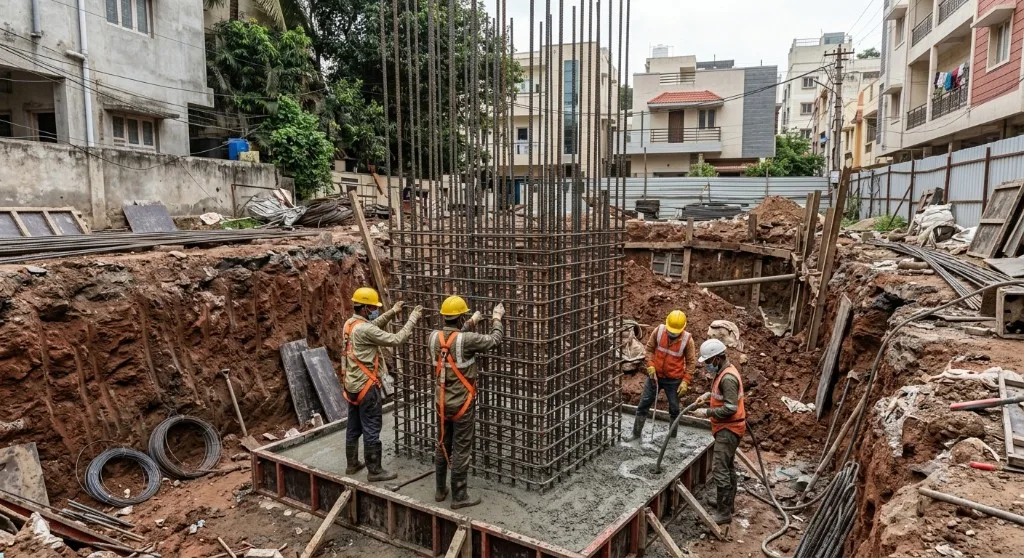
Accepting columns with stirrups pressed against plywood because the bar bender ran short of spacers is how Bangalore homes grow rust blooms that nobody sees until plaster pops ten years later.
Cover is the durable distance between steel and surface. Without it, Bangalore moisture and carbonation reach rebar — cracks and spalling follow.
This is a chapter of the Bangalore Construction Handbook under Structure & RCC — not a blog essay. Read it to reduce uncertainty before money, drawings, or excavation move. If you finish and still cannot name a next verification or estimate step, re-read the decision panel near the end.
Quick orientation
Keep these planning anchors visible while you read. They are orientation aids — not a quotation or sanction certificate.
| Item | Planning note |
|---|---|
| Decision unlocked | Inspect cover spacers before every cage pour |
| Cluster | Structure & RCC |
| Honesty rule | Indicative bands only — verify on plot |
Bangalore context you must not skip
Bangalore is not coastal, but monsoon wetting, poor cover and carbonation still corrode rebar in JP Nagar retrofits and northern corridor sites. Coastal-exposure myths should not excuse spacer laziness on any plotted home.
Authority boundaries, soil behaviour, monsoon calendars, and truck access change outcomes more than brochure finishes. Owners who treat Bangalore like a generic Indian city usually discover the gap at foundation or OC stage — when redesign is expensive.
Confirm which authority governs your survey number, what the soil report actually recommends, and whether your programme has a monsoon buffer before you negotiate a headline ₹/sq ft.
Corridors around Whitefield, HSR Layout, Sarjapur Road, Electronic City, Hebbal and Yelahanka do not share one construction playbook. Narrow approach roads, rocky outcrops beside soft fill, and incomplete layout conditions are ordinary — not exotic. Ask for plot-specific evidence, not a citywide average story.
Keep a digital project vault from week one: sanction set, soil report, structural drawings, stage photos, test certificates, and written change orders. Bangalore disputes after handover almost always lack the file that would have made the defect cheap to prove and fix.
The decision this chapter forces
Accepting columns with stirrups pressed against plywood because the bar bender ran short of spacers is how Bangalore homes grow rust blooms that nobody sees until plaster pops ten years later.
Cover is the durable distance between steel and surface. Without it, Bangalore moisture and carbonation reach rebar — cracks and spalling follow.
If you cannot state a next verification, estimate, or pause after reading, you are still collecting information — not deciding. Handbook chapters exist to close that loop for RCC cover corrosion.
Owners who treat this as optional reading usually pay twice: once for the optimistic path, and again when a banker, inspector, or first monsoon rejects that path. Decide with evidence, then spend.
Bangalore-specific realities
Bangalore is not coastal, but monsoon wetting, poor cover and carbonation still corrode rebar in JP Nagar retrofits and northern corridor sites. Coastal-exposure myths should not excuse spacer laziness on any plotted home.
Cover depth specified per element and exposure — drawings govern. Spacers/chairs maintain cover during pour — tying bar to formwork fails cover.
Carbonation front moves inward over years — adequate cover delays it. Cracks parallel to rebar invite faster corrosion.
Honeycomb exposes steel directly — repair before conceal. Chloride ingress risk rises with poor sand or contaminated materials.
Repair mortars need compatibility — cosmetic patch alone fails. Cover cannot be fixed after pour without structural consequence.
Fire and durability requirements also influence cover — engineer integrates. Photograph cages before pour — only audit trail for cover disputes.
Locality anecdotes from Whitefield, HSR, Sarjapur Road, Electronic City or North Bangalore corridors are useful only after you map them to your survey number, soil report and sanctioning authority. A working method three streets away can still be wrong for your plot.
- Cover depth specified per element and exposure — drawings govern.
- Spacers/chairs maintain cover during pour — tying bar to formwork fails cover.
- Carbonation front moves inward over years — adequate cover delays it.
- Cracks parallel to rebar invite faster corrosion.
- Honeycomb exposes steel directly — repair before conceal.
- Chloride ingress risk rises with poor sand or contaminated materials.
- Repair mortars need compatibility — cosmetic patch alone fails.
- Cover cannot be fixed after pour without structural consequence.
How professionals should brief you
Ask your architect, structural engineer or competent liaison to explain RCC cover corrosion in writing against your survey number — not as a generic city story. Good professionals welcome that request; vague ones talk in proverbs.
Require named assumptions: authority path, soil recommendation, envelope limits, material grades, and which hold points release payment. If those names are missing, you do not yet have a plan — you have a conversation.
Require cover inspection record: element, specified cover*, spacer type/count, spot measurements before pour — filed per column/slab cycle.
Bring this chapter’s checklist to the meeting. Ask which items are already satisfied, which need tests, and which are owner decisions versus engineer decisions. Ending a meeting without named owners for open items is how Bangalore projects drift.
Process
Stage sequence and hold points
Fix cages with spacers → measure cover → pour with vibration → inspect faces → repair honeycomb → map cracks → then plaster — never hide exposed steel.
Bangalore monsoon and supply variability mean calendars need buffers. A hold point is not hostility toward the contractor — it is how you keep cash aligned with verified work.
Hold point discipline for RCC cover corrosion: Cover spacers installed Also: Cover depth spot-check Release stage money only when evidence matches the written scope.
Hold point discipline for RCC cover corrosion: Honeycomb repair before hide Also: Crack map before plaster Release stage money only when evidence matches the written scope.
Hold point discipline for RCC cover corrosion: Cage photos archived Release stage money only when evidence matches the written scope.
- Cover spacers installed
- Cover depth spot-check
- Honeycomb repair before hide
- Crack map before plaster
- Cage photos archived
Watch out
Risk, rework and what “cheap” actually costs
Paint on rust is not corrosion protection. Cover at pour time is the main event.
Price the failure mode, not the line item. A slightly higher specification or a week of waiting is often cheaper than opening finished work in the first monsoon.
Failure modes to price early on RCC cover corrosion: Early corrosion and spalling Equally costly: Reduced fire/durability life Bangalore monsoon and resale diligence usually reveal these after cosmetic finishes hide the cause.
Failure modes to price early on RCC cover corrosion: Structural capacity loss if severe Equally costly: Expensive retrofit injection Bangalore monsoon and resale diligence usually reveal these after cosmetic finishes hide the cause.
Failure modes to price early on RCC cover corrosion: False sense from paint cover Bangalore monsoon and resale diligence usually reveal these after cosmetic finishes hide the cause.
- Early corrosion and spalling
- Reduced fire/durability life
- Structural capacity loss if severe
- Expensive retrofit injection
- False sense from paint cover
Owner inspection cues you can actually use
You do not need to become an engineer to refuse vague answers. For RCC cover corrosion, ask what evidence would convince a sceptical future buyer or lender. If the site team cannot name that evidence, pause.
Photograph interfaces before they are concealed: junctions, cover, falls, waterproofing layers, steel before pour, and any deviation from stamped drawings. Bangalore handover disputes almost always lack photos from the week the defect was cheap.
When quotes differ wildly on RCC cover corrosion, demand a scope reconciliation table — same grades, same exclusions, same monsoon assumptions — before crowning the cheapest bidder.
Connecting this chapter to money and services
Spacers cost paise; injection repair costs lakhs*. Inspect cages.
Commercial pages — Residential Construction, Villa Construction, Turnkey, Architectural & Structural Drawings, Structural RCC — exist to execute a decided scope. This chapter exists so you do not engage them with contradictory assumptions.
Related handbook siblings should be read as a learning path, not a link dump. Prefer the sequence noted below over opening twenty tabs.
If your plot constraints are non-standard (slope, black cotton, basement, edge jurisdiction), treat the calculator as a band and the site meeting as the decision — never the reverse.
Cover inspection log
One row per element per pour.
| Element | Spec cover* | Spacer OK? | Photo ref | Pour OK? |
|---|---|---|---|---|
| Footing | Per drawing* | Y/N | File name | Y/N |
| Column | Per drawing* | Y/N | File name | Y/N |
| Beam | Per drawing* | Y/N | File name | Y/N |
| Slab | Per drawing* | Y/N | File name | Y/N |
| Stair | Per drawing* | Y/N | File name | Y/N |
Money
How this topic moves cost and time
Repair windows close fast after pour — inspect same day where possible.
Indicative bands below are planning anchors for Bangalore plotted residential work. They are not purchase orders. Refresh against current dealer quotes, structural drawings, and the Construction Cost Calculator before you treat any number as a commitment.
| Driver | Indicative impact | Owner control |
|---|---|---|
| No spacers | Corrosion path | Reject cage |
| Honeycomb patched hide | Rust later | Proper repair |
| Crack ignored pre-plaster | Corrosion highway | Map and treat |
| Cheap sand chlorides | Accelerated rust | Test sand |
Watch out
Common Bangalore mistakes on this topic
Most failures here are sequence failures: skipping a document, substituting a grade, or pouring before a hold point. Use the table as a pre-mortem before you sign or excavate.
| Mistake | Why it hurts | Prevention |
|---|---|---|
| Bars tied to formwork | Zero cover | Spacer audit |
| Cut spacers to save time | Thin cover spots | Full count |
| Plaster over rust | Ongoing corrosion | Clean and treat |
| Assume inland no rust | Monsoon still wets | Cover discipline |
Checklist
Owner verification checklist
- Cover spec known per element
- Spacers on every cage
- Spot measure before pour
- Honeycomb logged and repaired
- Crack map pre-plaster
- Sand/chloride diligence
- Cage photos stored
- No plaster over exposed steel
Tick items with evidence — photos, test reports, stamped drawings, or written stage certificates — not verbal reassurance. Bangalore disputes after handover almost always lack a paper trail at the stage when the defect was still cheap to fix.
Compare
Prevention vs repair
Prevention at cage stage wins.
| Stage | Prevention | Repair later | Cost bias |
|---|---|---|---|
| Before pour | Spacers + inspect | N/A | Cheapest |
| After pour honeycomb | Chip and repair | Injection | Moderate* |
| Post-handover rust | N/A | Breakout/repair | Expensive* |
What should I do next on RCC cover and corrosion?
Use this panel when you are stuck. Pick the row that matches your situation, then take that action — do not collect more tabs.
| Situation | What to do next |
|---|---|
| Spacers missing | Stop pour; fix cage. |
| Honeycomb visible | Repair method approved before plaster. |
| Cracks before plaster | Engineer classifies — map them. |
| Rust seen early | Do not plaster over — treat steel. |
| Cover dispute after pour | Use pre-pour photos; prevention next cycle. |
Where this sits in the handbook sequence
Read Formwork and Curing chapters as pour cycle bookends. Steel selection for grade coherence.
Educational order for most plot owners: confirm documents and authority → soil and foundation logic → structure and materials literacy → MEP coordination → finishes → handover checks. Jumping to elevation moodboards before sanctionable massing and soil data is how Bangalore projects redraw columns after “final” interiors.
When you need a budget band, run the Construction Cost Calculator with the same built-up and package assumptions this chapter implies. When you need human judgment on a survey-number constraint, talk through scope with an engineer — calculators do not replace soil reports or sanction scrutiny.
Use related handbook siblings as a learning path: read the chapter that unlocks your next hold point, then estimate, then engage the matching service page with identical assumptions. Opening twenty tabs without a decision owner is how families lose weeks and still cannot name what to do next.
If you are already mid-build and this chapter names a risk you skipped, stop silent substitutions, document as-built reality, and seek engineering advice before more finishing spend conceals the interface. Late honesty is cheaper than monsoon-season rip-outs.
Honest limits of this chapter
Rules, fees, and portal workflows change. Treat process steps as a checklist to verify on the current BBMP / BDA / BMRDA / local planning authority guidance for your survey number — not as a permanent statute reprint. Material rates move weekly.
Structural sizes come from your engineer’s drawings, not from handbook tables. VDM publishes this chapter so you can ask better questions and refuse silent substitutions — not so you can self-certify a building.
If a contractor, liaison or seller contradicts this chapter with certainty and no documents, pause. Bangalore’s expensive lessons usually begin with confidence that could not be filed. Prefer one verified next step over ten optimistic opinions.
Frequently asked questions
Clear distance from rebar to concrete surface — protects steel.
Keep rebar off formwork during pour.
Yes with moisture, cracks, poor cover — not coastal-only.
Too late for design cover — prevention only.
Expose steel — proper repair required.
Cracks speed ingress — classify early.
Bad sand accelerates — test aggregates.
Not durable fix — steel must be treated.