Guide
Villa Construction Mistakes to Avoid in Bangalore
The most expensive villa construction mistakes in Bangalore — scope gaps, outdoor surprises, waterproofing shortcuts, weak contracts and rushed finishes.
Quick summary
The most expensive villa construction mistakes in Bangalore — scope gaps, outdoor surprises, waterproofing shortcuts, weak contracts and rushed finishes.
Quick Summary
Most expensive villa failures in Bangalore are not mysterious acts of fate — they are predictable mistakes made early: budgeting a villa like a compact house, skipping soil investigation, treating outdoor works as decoration, under-designing long spans and double-height volumes, and paying ahead of verified stages.
This chapter catalogues the mistakes we see repeatedly across Whitefield, Sarjapur Road, Kanakapura Road, Bannerghatta Road stretches, and Yelahanka villa plots, and turns each one into a prevention rule you can apply before contracts are signed.
Every mistake below either weakens your villa construction outcome or quietly transfers risk onto you. Use it as a pre-bid audit when comparing contractors, and as a mid-project warning list when pressure rises to “keep things moving.”
Watch out
Mistake 1 — Budgeting a villa with a house rate
Owners often begin with a per-square-foot number borrowed from a friend’s G+1 house on a 30×40 plot. Villa geometry breaks that number.
Longer spans, more wet areas, larger terraces, compound development, and higher average joinery specification push both structure and finishing above compact-house bands. Outdoor works alone can rival a finishing upgrade if driveways, retaining walls, and boundary treatment are real.
Prevention: build a villa-specific estimate with outdoor works as separate lines. Use the villa construction cost guide and the villa construction cost calculator before you fall in love with a finish brochure. Compare bids with an inclusions matrix, not headlines.
| Budget error | What gets underfunded | Typical consequence |
|---|---|---|
| House rate on villa area | Structure, waterproofing, outdoor works | Variations and quality cuts mid-project |
| Ignoring slope / retaining | Foundations and drainage | Large early variation after excavation |
| Finishes first contingency last | Membranes, cover, curing discipline | Pretty rooms with chronic leaks |
| No outdoor line items | Driveway, compound, gates, lighting | “Temporary” access that becomes permanent mess |
Watch out
Mistake 2 — Skipping or ignoring soil investigation
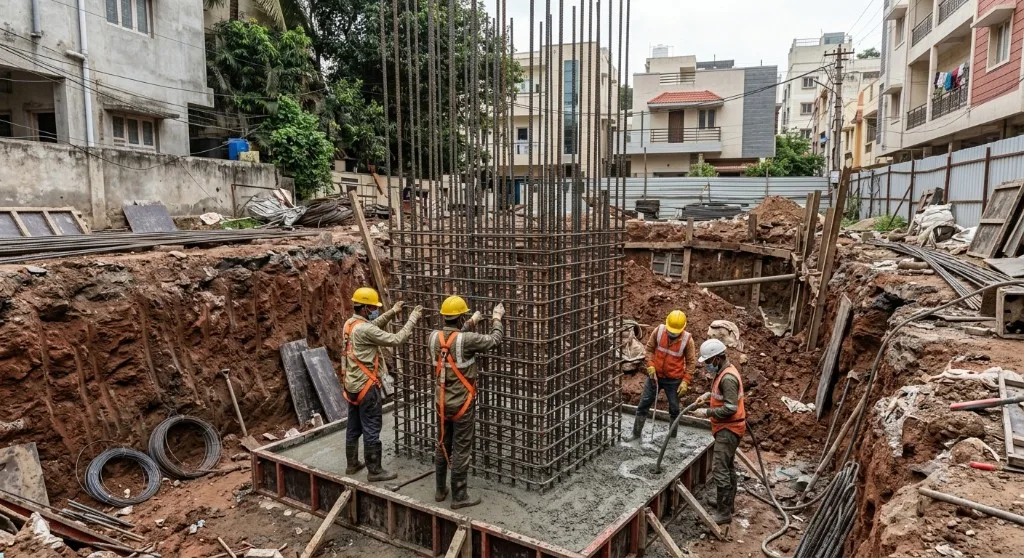
Copying a neighbour’s footing sizes on a Sarjapur or Kanakapura plot is still common. Fill pockets, soft strata near old drainage lines, and seasonal water tables do not respect layout marketing.
A villa’s larger footprint amplifies foundation risk: more load, more excavation volume, and more expensive redesign if the wrong system was assumed.
Prevention: make the soil report an annexure to structural design and to every contractor quote. If two bids assume different foundation systems, you are not comparing prices — you are comparing fantasies.
Watch out
Mistake 3 — Freezing pretty plans before structural grid and services
Double-height living rooms, large corner windows, and column-free family halls are legitimate villa ambitions. They are not free. When architecture is approved emotionally and structure is asked to “make it work” later, beam depths, transfer elements, and cost escalate — or worse, detailing is diluted on site.
Prevention: run architectural massing and structural RCC scheme together. Read our chapter on double-height living structure cost before you insist on a void that your budget cannot carry. Coordinate MEP shafts before brickwork closes.
Watch out
Mistake 4 — Treating waterproofing as a product purchase
Buying “a good chemical” does not waterproof a villa. Surface preparation, upstands, parapet fillets, door thresholds, planter detailing, and flood testing decide outcomes. Large villa terraces and multiple balconies multiply junctions. Bangalore monsoon finds every weak corner.
Prevention: specify the system, coat count, protection screed, and test protocol in the contract. Tie a payment stage to witnessed flood tests through your waterproofing scope. Never tile over an untested membrane because the interior designer’s schedule is aggressive.
| Waterproofing shortcut | Why it fails in Bangalore | Correct practice |
|---|---|---|
| No flood test | Leaks appear after move-in, leverage gone | Witnessed test before tiling/decking |
| Broken parapet detailing | Rain drives into wall-slab junction | Fillet, membrane continuity, coping design |
| Planter as afterthought | Root and water load on unprepared slab | Designed waterproofing and drainage layer |
| Threshold without upstand | Balcony water enters living areas | Detail upstand and door sill early |
Watch out
Mistake 5 — Outdoor works as Phase Two fantasy
Owners postpone driveway falls, compound drainage, and gate foundations to “after we move in.” Water then ponds at the plinth, temporary mud tracks damage finishes, and outdoor kitchens appear without electrical or plumbing provisions. Villa living is plot living; the building and the ground plane must be designed together.
Prevention: include outdoor works in the same drawing set and cash-flow plan as the house. Even if landscaping softscape is phased, hardscape drainage and services stubs must be decided during villa construction, not improvised later.
Watch out
Mistake 6 — Weak contracts and front-loaded payments
WhatsApp scope, vague “premium finishing,” and large advances without mobilisation definitions destroy owner leverage. Villa projects run long enough for memories to diverge. Without annexured drawings, make-lists, payment stages, and variation rules, every disagreement becomes a negotiation under time pressure.
Prevention: use a written contract with drawings hierarchy, exclusions list, and stage payments tied to verified work. Study villa construction contracts and villa payment schedules before you sign. Hold retention through handover checks described in villa handover checklist.
Watch out
Mistake 7 — Material selection by brochure emotion
Imported stone everywhere, mismatched waterproofing under premium tiles, and windows chosen for looks without thermal or hardware performance create maintenance burden.
Villa material selection should follow exposure, maintenance capacity, and structural compatibility — not only social media mood boards. See villa material selection and villa finishing guide.
| Emotion-led choice | Technical risk | Better decision rule |
|---|---|---|
| Dark large-format floor throughout | Shows undulation; heavy handling breakage | Match format to substrate flatness capability |
| Floor-to-ceiling glass west face | Heat gain, glare, AC load | Orientation-aware glazing and shading |
| Cheapest exterior paint on large elevation | Fade and algae on monsoon walls | System-rated exterior coating with primer |
| Mixed sanitary brands without spares plan | Maintenance frustration | Standardise critical fittings by zone |
Watch out
Mistake 8 — Ignoring monsoon and logistics reality
Aggressive schedules that pour slabs and waterproof terraces in peak rain without protection plans produce curing failures and membrane contamination. Corridor plots with narrow internal roads cannot accept full-size RMC trucks without a pumping plan. Discovering this on pour day is a self-inflicted crisis.
Prevention: put monsoon buffers into the programme. Confirm truck access for Whitefield and Sarjapur layouts before structural planning assumes RMC. Align curing and waterproofing windows with weather, not optimism.
Decision Framework
Before you approve a villa decision, ask:
- Does this choice assume house-scale cost, structure, or logistics? If yes, stop and re-estimate.
- Is there a drawing, specification, and test method — or only a verbal assurance?
- Will this decision still look wise after the first full Bangalore monsoon?
- Does payment still follow verified work after this change?
- If we reverse this later, is the cost proportional — or are we pouring permanent regret?
If any answer is weak, delay the decision. Villa speed without sequence is how mistakes compound.
Professional recommendations
Run a mistakes audit at three moments: before signing, at foundation gate, and before finishing procurement locks. Assign an owner for each risk line — architect, structural engineer, contractor, or owner. Keep a simple risk register: item, consequence, prevention evidence, status.
VDM’s villa programmes treat this register as project hygiene, not bureaucracy.
For corridor-specific diligence, walk the plot after rain in Sarjapur Road and outer Whitefield layouts. Standing water and neighbour drain directions reveal more than a sunny brochure visit. Confirm planning authority and setbacks early so design mistakes do not become demolition orders.
Watch out
Common mistakes checklist (print this)
- No soil report annexed to structural design
- Villa budget based on compact-house rate
- Outdoor drainage excluded “for later”
- Double-height or long spans without structural cost sign-off
- Waterproofing without flood-test milestone
- Large advance without mobilisation definition
- Make-list absent or “as per architect” with no baseline
- Finishing trades starting before substrate and MEP tests
- No retention through handover and first monsoon
- Document pack treated as optional paperwork
FAQ
FAQs
What is the single costliest villa mistake in Bangalore?
Usually a cluster: wrong foundation assumption plus incomplete waterproofing detailing, discovered after finishing money is spent. Prevention is soil data, structural discipline, and flood tests before tiles.
Can a low quote still be safe?
Only if scope matches yours line by line. A low quote that excludes compound works, waterproofing system grade, or long-span steel is not cheaper — it is incomplete.
Are gated community villas safer from these mistakes?
Not automatically. Community rules may constrain elevation and setbacks, but private waterproofing, foundation adequacy, and contract quality remain your problem.
How do NRI owners avoid remote construction mistakes?
Demand stage photos tied to checklists, third-party inspection at foundation and waterproofing gates, and payment against verified milestones — not calendar optimism.
Where should I start if design is already frozen?
Audit structure, waterproofing details, outdoor drainage, and contract payment logic immediately. Change drawings now if needed; concrete is less forgiving than PDF revisions.
Final CTA
If you want a villa programme designed to avoid these failure modes — not merely to react after they appear — engage VDM Constructions early. Review our villa construction approach, then contact us with your plot location, soil status, and drawings. We will give you an honest risk list before you pour money into preventable mistakes.
More questions
Starting without a written outdoor and finish scope. Landscape, pool and façade upgrades added mid-build destroy budgets faster than most material price rises.
Often yes when outdoor works, waterproofing systems and brand bands are undefined. Compare inclusions, not slogans.
Some snags yes; structural and waterproofing failures are far costlier after finishes. Prevention at design and stage gates is cheaper.