Guide
Founding Depth and Monsoon Planning in Bangalore
How monsoon seasons should influence founding depth, excavation timing, dewatering and plinth protection on Bangalore homes — calendar discipline owners can enforce.
Quick summary
How monsoon seasons should influence founding depth, excavation timing, dewatering and plinth protection on Bangalore homes — calendar discipline owners can enforce.
Key takeaways
- Monsoon is a planning input — not a surprise.
- Open pits are expensive in rain — close founding fast.
- Never pour footings on uninspected slurry.
- Calendar buffers beat dispute later.
What this chapter helps you decide
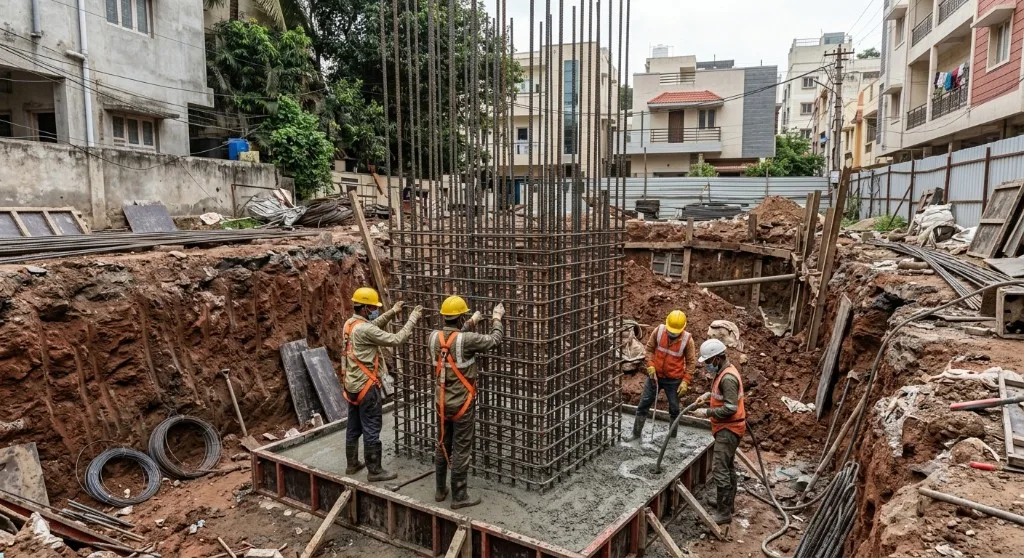
Scheduling excavation for May because the contractor needs to show progress is how Bangalore pits fill with red mud water and footings get poured on slurry — then blamed on bad luck.
Monsoon is not an excuse — it is a design and calendar input. Founding depth, open-pit time, dewatering and curing windows should be planned, not improvised when clouds arrive.
This is a chapter of the Bangalore Construction Handbook under Foundation & Soil — not a blog essay. Read it to reduce uncertainty before money, drawings, or excavation move. If you finish and still cannot name a next verification or estimate step, re-read the decision panel near the end.
Quick orientation
Keep these planning anchors visible while you read. They are orientation aids — not a quotation or sanction certificate.
| Item | Planning note |
|---|---|
| Decision unlocked | Plan excavation windows around Bangalore monsoon |
| Cluster | Foundation & Soil |
| Honesty rule | Indicative bands only — verify on plot |
Bangalore context you must not skip
Bangalore monsoon roughly June–October stresses open excavations, expansive soils and basement digs across Whitefield, Electronic City, Yelahanka and core city infill. Seasonal high groundwater, softened cut slopes and rushed pours create defects that surface as damp plinths and cracked plinth beams.
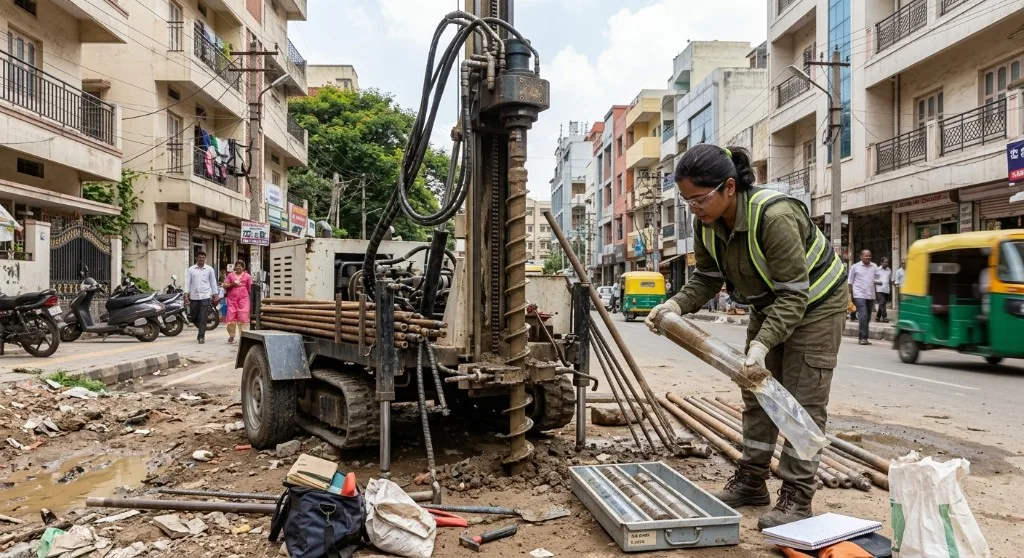
Authority boundaries, soil behaviour, monsoon calendars, and truck access change outcomes more than brochure finishes. Owners who treat Bangalore like a generic Indian city usually discover the gap at foundation or OC stage — when redesign is expensive.
Confirm which authority governs your survey number, what the soil report actually recommends, and whether your programme has a monsoon buffer before you negotiate a headline ₹/sq ft.
Corridors around Whitefield, HSR Layout, Sarjapur Road, Electronic City, Hebbal and Yelahanka do not share one construction playbook. Narrow approach roads, rocky outcrops beside soft fill, and incomplete layout conditions are ordinary — not exotic. Ask for plot-specific evidence, not a citywide average story.
Keep a digital project vault from week one: sanction set, soil report, structural drawings, stage photos, test certificates, and written change orders. Bangalore disputes after handover almost always lack the file that would have made the defect cheap to prove and fix.
The decision this chapter forces
Scheduling excavation for May because the contractor needs to show progress is how Bangalore pits fill with red mud water and footings get poured on slurry — then blamed on bad luck.
Monsoon is not an excuse — it is a design and calendar input. Founding depth, open-pit time, dewatering and curing windows should be planned, not improvised when clouds arrive.
If you cannot state a next verification, estimate, or pause after reading, you are still collecting information — not deciding. Handbook chapters exist to close that loop for founding depth monsoon.
Owners who treat this as optional reading usually pay twice: once for the optimistic path, and again when a banker, inspector, or first monsoon rejects that path. Decide with evidence, then spend.
Bangalore-specific realities
Bangalore monsoon roughly June–October stresses open excavations, expansive soils and basement digs across Whitefield, Electronic City, Yelahanka and core city infill. Seasonal high groundwater, softened cut slopes and rushed pours create defects that surface as damp plinths and cracked plinth beams.
Founding depth is a structural and geotechnical decision — monsoon informs timing, not depth shortcuts. Open excavations through monsoon need dewatering, shoring and slope protection.
Pouring footings in saturated trenches without proper preparation weakens bearing. Curing during heavy rain needs protection — not abandonment.
Plinth protection and backfill timing matter for seasonal moisture entry. Calendar buffers before monsoon reduce pit exposure cost.
Expansive soils swell most when founding sits in seasonal wet profile — depth matters. Documentation of weather delays protects fair extension discussions — not blame games.
Neighbour drains overflow in monsoon — site grading must not worsen it. Post-monsoon inspection before superstructure rush catches slumped trenches.
Locality anecdotes from Whitefield, HSR, Sarjapur Road, Electronic City or North Bangalore corridors are useful only after you map them to your survey number, soil report and sanctioning authority. A working method three streets away can still be wrong for your plot.
- Founding depth is a structural and geotechnical decision — monsoon informs timing, not depth shortcuts.
- Open excavations through monsoon need dewatering, shoring and slope protection.
- Pouring footings in saturated trenches without proper preparation weakens bearing.
- Curing during heavy rain needs protection — not abandonment.
- Plinth protection and backfill timing matter for seasonal moisture entry.
- Calendar buffers before monsoon reduce pit exposure cost.
- Expansive soils swell most when founding sits in seasonal wet profile — depth matters.
- Documentation of weather delays protects fair extension discussions — not blame games.
How professionals should brief you
Ask your architect, structural engineer or competent liaison to explain founding depth monsoon in writing against your survey number — not as a generic city story. Good professionals welcome that request; vague ones talk in proverbs.
Require named assumptions: authority path, soil recommendation, envelope limits, material grades, and which hold points release payment. If those names are missing, you do not yet have a plan — you have a conversation.
Ask for an excavation calendar: planned start, monsoon overlap, dewatering contingency*, founding closure target, and hold points if groundwater rises — signed by structural lead.
Bring this chapter’s checklist to the meeting. Ask which items are already satisfied, which need tests, and which are owner decisions versus engineer decisions. Ending a meeting without named owners for open items is how Bangalore projects drift.
Process
Stage sequence and hold points
Plan excavation outside peak monsoon where possible → if overlap, specify dewatering and shoring → inspect founding base dry and clean → pour with curing protection → protect plinth through next rains → proceed superstructure.
Bangalore monsoon and supply variability mean calendars need buffers. A hold point is not hostility toward the contractor — it is how you keep cash aligned with verified work.
Hold point discipline for founding depth monsoon: Excavation window planned vs monsoon Also: Dewatering method written if wet season dig Release stage money only when evidence matches the written scope.
Hold point discipline for founding depth monsoon: Founding inspection before pour in wet conditions Also: Curing protection specified Release stage money only when evidence matches the written scope.
Hold point discipline for founding depth monsoon: Plinth backfill after drain paths clear Release stage money only when evidence matches the written scope.
- Excavation window planned vs monsoon
- Dewatering method written if wet season dig
- Founding inspection before pour in wet conditions
- Curing protection specified
- Plinth backfill after drain paths clear
Watch out
Risk, rework and what “cheap” actually costs
Contractors who treat monsoon as force majeure for every mistake hide planning failure. Weather is known; open pits are a choice.
Price the failure mode, not the line item. A slightly higher specification or a week of waiting is often cheaper than opening finished work in the first monsoon.
Failure modes to price early on founding depth monsoon: Slurry pours and weak footings Equally costly: Open pit collapse / neighbour damage Bangalore monsoon and resale diligence usually reveal these after cosmetic finishes hide the cause.
Failure modes to price early on founding depth monsoon: Programme fiction ignoring rain days Equally costly: Damp plinth from early backfill Bangalore monsoon and resale diligence usually reveal these after cosmetic finishes hide the cause.
Failure modes to price early on founding depth monsoon: Disputes over weather extensions Bangalore monsoon and resale diligence usually reveal these after cosmetic finishes hide the cause.
- Slurry pours and weak footings
- Open pit collapse / neighbour damage
- Programme fiction ignoring rain days
- Damp plinth from early backfill
- Disputes over weather extensions
Owner inspection cues you can actually use
You do not need to become an engineer to refuse vague answers. For founding depth monsoon, ask what evidence would convince a sceptical future buyer or lender. If the site team cannot name that evidence, pause.
Photograph interfaces before they are concealed: junctions, cover, falls, waterproofing layers, steel before pour, and any deviation from stamped drawings. Bangalore handover disputes almost always lack photos from the week the defect was cheap.
When quotes differ wildly on founding depth monsoon, demand a scope reconciliation table — same grades, same exclusions, same monsoon assumptions — before crowning the cheapest bidder.
Connecting this chapter to money and services
Budget dewatering and lost days as line items*, not surprises. Cheap calendar optimism costs more in rework than honest buffers.
Commercial pages — Residential Construction, Villa Construction, Turnkey, Architectural & Structural Drawings, Structural RCC — exist to execute a decided scope. This chapter exists so you do not engage them with contradictory assumptions.
Related handbook siblings should be read as a learning path, not a link dump. Prefer the sequence noted below over opening twenty tabs.
If your plot constraints are non-standard (slope, black cotton, basement, edge jurisdiction), treat the calculator as a band and the site meeting as the decision — never the reverse.
Checklist
Monsoon foundation stage gate checklist
Use weekly during overlapping seasons.
| Stage | Gate question | Pass criteria | Fail action |
|---|---|---|---|
| Excavation open | Is dewatering running? | Dry working platform | Stop dig; pump plan |
| Founding base | Soft slurry present? | Clean firm stratum visible | Re-excavate to level |
| Pre-pour | Engineer inspected? | Signed readiness | Delay pour |
| Curing | Protected from rain? | Cover/compound in place | Fix before load |
| Plinth backfill | Drains functional? | Water exits site | Fix drains first |
Money
How this topic moves cost and time
Monsoon overlap can add weeks*. Price pumps, labour idle days and re-excavation — or shift founding to drier window.
Indicative bands below are planning anchors for Bangalore plotted residential work. They are not purchase orders. Refresh against current dealer quotes, structural drawings, and the Construction Cost Calculator before you treat any number as a commitment.
| Driver | Indicative impact | Owner control |
|---|---|---|
| Dig without dewatering plan | Slurry pour / delay | Calendar + pump spec |
| Open pit all monsoon | Collapse / neighbour risk | Close founding faster |
| Skip wet-trench inspection | Weak bearing | Engineer sign-off |
| Backfill before drains work | Damp plinth | Sequence drains first |
Watch out
Common Bangalore mistakes on this topic
Most failures here are sequence failures: skipping a document, substituting a grade, or pouring before a hold point. Use the table as a pre-mortem before you sign or excavate.
| Mistake | Why it hurts | Prevention |
|---|---|---|
| May excavation on expansive soil | Swollen trench walls | Shift or shore properly |
| Poured in standing water | Weak footings | Pump and inspect base |
| No curing cover in rain | Surface defects | Tarp and compound |
| Blamed monsoon for no planning | Dispute | Written calendar upfront |
Checklist
Owner verification checklist
- Excavation calendar vs monsoon documented
- Dewatering plan if wet-season dig
- Founding base inspection record
- Curing protection materials on site
- Slope / shoring for cut plots
- Stormwater not directed to neighbour
- Photo log of weather delays
- Post-monsoon plinth inspection done
Tick items with evidence — photos, test reports, stamped drawings, or written stage certificates — not verbal reassurance. Bangalore disputes after handover almost always lack a paper trail at the stage when the defect was still cheap to fix.
Compare
Excavate pre-monsoon vs during vs after
Honest calendar beats heroics.
| Timing | When honest | When it fails |
|---|---|---|
| Pre-monsoon close founding | Stable soil, short window | Rushed slurry pour anyway |
| Monsoon dig with dewatering | Basement / hard deadline | No pump plan |
| Post-monsoon start | Flexible programme | Contractor idle cost ignored |
What should I do next on founding depth and monsoon?
Use this panel when you are stuck. Pick the row that matches your situation, then take that action — do not collect more tabs.
| Situation | What to do next |
|---|---|
| Monsoon 6 weeks away, pit open | Accelerate founding closure or engineer dewatering — not hope. |
| Standing water in trench | Stop pour; pump and inspect — no slurry compromise. |
| Expansive soil + wet season | Extra shoring and quick closure — read black cotton chapter. |
| Contractor claims rain delay | Compare to agreed calendar and photos. |
| Plinth damp after first rains | Check drainage and backfill sequence — not paint only. |
Where this sits in the handbook sequence
Read with Black Cotton Soil, Pile Foundations, Slope Plot and Excavation Checklist chapters. Concrete curing chapter in Wave 2 for superstructure rains.
Educational order for most plot owners: confirm documents and authority → soil and foundation logic → structure and materials literacy → MEP coordination → finishes → handover checks. Jumping to elevation moodboards before sanctionable massing and soil data is how Bangalore projects redraw columns after “final” interiors.
When you need a budget band, run the Construction Cost Calculator with the same built-up and package assumptions this chapter implies. When you need human judgment on a survey-number constraint, talk through scope with an engineer — calculators do not replace soil reports or sanction scrutiny.
Use related handbook siblings as a learning path: read the chapter that unlocks your next hold point, then estimate, then engage the matching service page with identical assumptions. Opening twenty tabs without a decision owner is how families lose weeks and still cannot name what to do next.
If you are already mid-build and this chapter names a risk you skipped, stop silent substitutions, document as-built reality, and seek engineering advice before more finishing spend conceals the interface. Late honesty is cheaper than monsoon-season rip-outs.
Honest limits of this chapter
Rules, fees, and portal workflows change. Treat process steps as a checklist to verify on the current BBMP / BDA / BMRDA / local planning authority guidance for your survey number — not as a permanent statute reprint. Material rates move weekly.
Structural sizes come from your engineer’s drawings, not from handbook tables. VDM publishes this chapter so you can ask better questions and refuse silent substitutions — not so you can self-certify a building.
If a contractor, liaison or seller contradicts this chapter with certainty and no documents, pause. Bangalore’s expensive lessons usually begin with confidence that could not be filed. Prefer one verified next step over ten optimistic opinions.
Frequently asked questions
Depth is engineering-led; monsoon mainly affects timing and open-pit risk.
Varies by year and soil — plan buffers, not superstition.
Only with proper base prep, protection and engineer approval — not in slurry.
Pumping or drainage to keep excavation workable — costs money*.
High risk — close founding or engineer shoring and dewatering.
Extra care — read black cotton chapter; swell worsens wet trenches.
Owner site log + photos; compare to agreed calendar.
Cover slabs and footings; continue minimum curing discipline.